
App Service, Container Apps or AKS: choose the right Azure home
Compare three Azure application platforms by the control your workload needs and the operational work your team is ready to own.
A container does not settle the hosting decision
Packaging an application in a container makes an artifact portable. It does not decide who will handle deployment, networking, scaling and platform operations. Those responsibilities should drive the hosting conversation.
Microsoft documents several Azure container options. This guide focuses on App Service, Container Apps and Azure Kubernetes Service, using their documented service models as a starting point. The selection workflow is worqcloud’s recommendation, not a provider ranking.
1. Start with the application experience you need
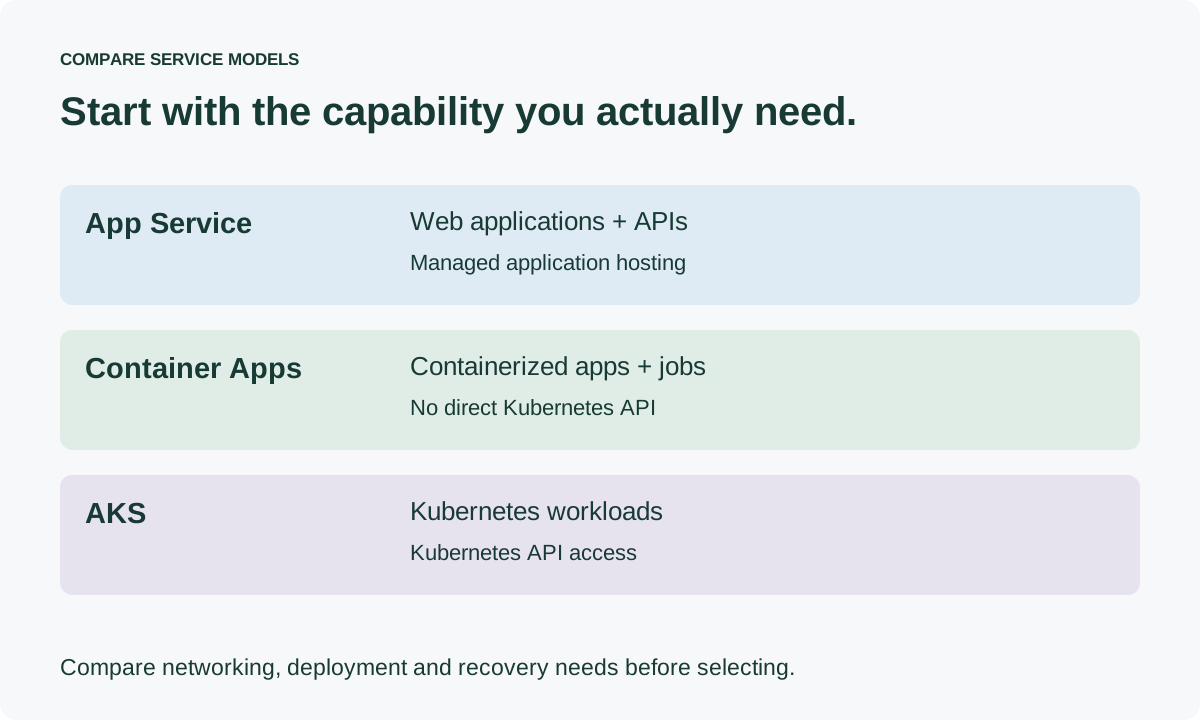
App Service is a managed hosting option for websites and APIs, with code and container deployment choices. Container Apps focuses on containerized applications and jobs, including event-driven patterns and revision-based deployment. AKS provides Kubernetes API access for Kubernetes workloads.
That distinction is more useful than calling one service universally simpler or cheaper. Write down whether the application is an HTTP service, a background worker or a scheduled job, then list the deployment and integration requirements it actually has.
Microsoft’s comparison says Container Apps does not expose the underlying Kubernetes APIs. A need for those APIs is therefore a concrete reason to assess AKS; having a Dockerfile alone is not.
2. Define control as a requirement, not a preference
Ask which platform-level behavior must be customized. Consider networking, workload isolation, hardware requirements and deployment tooling. Microsoft’s architecture guide compares these controls across container services and notes that flexibility differs.
Our recommendation is to name the capability that disqualifies a managed application platform before accepting more orchestration work. If nobody can identify it, build a small compatibility test rather than a large cluster design.
For AKS, specify the experience model being evaluated and verify the current division of responsibilities. “Managed Kubernetes” should not be used as shorthand for having no application, security or operational work.
3. Test the entire request and release path
Deploy a representative slice of the real application. Include authentication, database connectivity, configuration, secret access and logging. A hello-world response is too small a test of production compatibility.
Exercise deployment and rollback with the team that will support the service. Measure startup behavior and response time at expected demand. Test the application when a dependency is unavailable, rather than checking only the healthy path.
Microsoft documents scale-to-zero scenarios for Container Apps. Whether that suits your application depends on its configuration and latency requirements; do not assume every workload or plan behaves identically.
4. Compare costs using the same service requirements
Evaluate ordinary demand, quiet periods and peak demand with matching availability and recovery expectations. Include supporting services, network transfer, observability and engineering effort. Check current regional availability, quotas and pricing before procurement.
- Which requirement determines the hosting choice?
- What will our team still need to patch, monitor and recover?
- Can we release and roll back safely using existing skills?
- Have we tested the most important integration and demand assumptions?
Do not use a single resource price as a proxy for the whole solution. This article deliberately makes no cost ranking: the useful comparison is specific to your traffic pattern, service requirements and operating model.
Choose the smallest operational surface that fits
Record the selected service, the alternatives rejected and the evidence behind the decision. Keep an exit consideration such as data export or deployment portability, but avoid paying for hypothetical flexibility without a defined use.
The best first choice is one the team can explain, test and operate. Revisit it when the workload changes enough to invalidate the original assumptions.