
Build a cloud portfolio that shows how you operate, not just deploy
Turn one small application into evidence of troubleshooting, recovery and engineering judgement—without pretending a personal lab is production experience.

A working URL tells only part of the story
A portfolio application proves that something can be deployed. A stronger portfolio also lets a reviewer understand the decisions behind it, see how failures were investigated and follow the steps needed to recover it. Those details turn a demonstration into a useful technical conversation.
This is a practical portfolio guide, not a claim about hiring volumes or salary growth. Job requirements vary by employer and region. Use the roles you are actually considering to decide which skills and evidence deserve your time.
Read a role description as a set of observable tasks
Collect a few relevant job descriptions and separate activities from product names. “Operate a service” might mean investigating alerts, managing access, recovering data or controlling cost. A long list of technologies does not explain which of those activities you can demonstrate.
AWS describes its CloudOps Engineer associate credential in terms that include monitoring, maintenance, security, networking, continuity, cost and performance. The Linux Foundation’s KCNA description covers foundational Kubernetes and cloud-native knowledge. These are useful scope references, not evidence that either certification guarantees employment.
Our recommendation is to choose one role direction for the project. A cloud support portfolio can emphasize diagnosis and communication; a platform-oriented project can emphasize repeatable deployment and developer experience.
Build one coherent service with a small operating surface
Choose an application simple enough to explain in a few minutes. Describe its users, data, dependencies and expected behavior. Keep the cloud footprint small and set a budget boundary before creating resources.
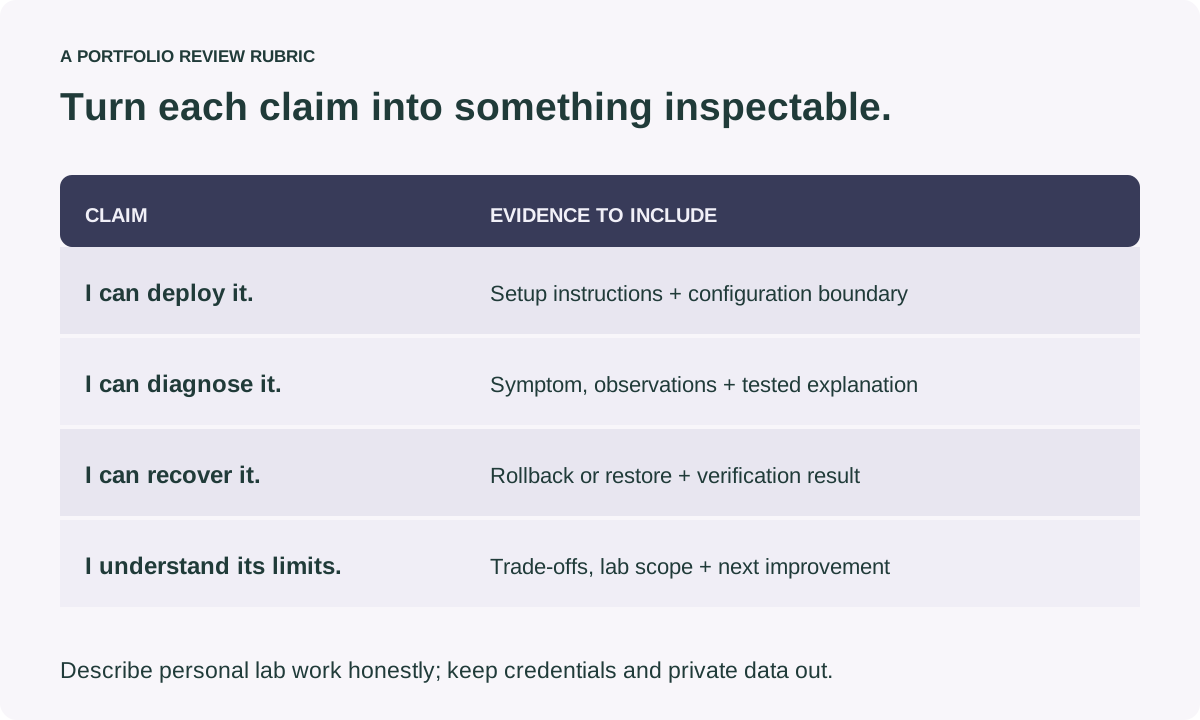
Document how the service is deployed from source, how configuration is supplied and how sensitive values are kept out of the repository. Provide a reproducible setup and teardown procedure. A reviewer should not need your personal credentials to understand the design.
Make the limitations visible. A single-instance lab may be suitable for learning but has different availability characteristics from a redundant production service. State the trade-off instead of adding an enterprise label to a small demonstration.
Add a troubleshooting record that another person can follow
Introduce a controlled failure in an isolated lab: a wrong port, an unavailable dependency or an invalid configuration. Record the symptom, the observations, the competing explanations and the change that resolved it.
Show why the evidence supported your conclusion. Logs, a network check or a health response are more useful when their role in the investigation is explained. Redact secrets and personal information before publishing any artifact.
Finish with a verification step and a prevention idea. Avoid presenting a deliberate lab exercise as a real customer incident. The value is the reasoning you can defend, not the apparent drama of the outage.
Demonstrate recovery and ongoing ownership
Walk through a rollback or restore procedure and record what it does and does not recover. Check that the result is usable; a successful command exit is not the same as a healthy application. If the project stores no important state, explain that boundary rather than manufacturing a backup requirement.
- A short architecture note with the main trade-offs.
- A setup guide and teardown instructions with cost considerations.
- One reproducible troubleshooting exercise with redacted evidence.
- A recovery or rollback walkthrough with a verification result.
- A list of known limitations and the next improvement you would make.
Use certification to organize learning, then show the work
An exam guide can help expose gaps and organize study. The portfolio demonstrates how you apply knowledge within a specific system. Keep the two complementary: a badge does not explain a design decision, and a deployed demo does not prove the full scope of a credential.
In applications and interviews, describe what you personally built, what you tested and where you needed help. Give reviewers a clear route through the evidence. Honest, understandable work creates a better discussion than an inflated claim that the project cannot support.