
FinOps beyond the bill: measure cost per business outcome
Understand ownership, shared costs and unit economics before treating a smaller cloud bill as evidence of a better business.
A lower bill can still tell the wrong story
A falling cloud bill looks encouraging until you discover that fewer customers completed orders. A growing bill can look alarming even while the business serves more customers at a lower cost per transaction. Total spend matters, but it needs context.
The FinOps Foundation separates cost allocation, unit economics and rate optimization into related capabilities. We summarize those ideas here and use them to build an original review checklist. There are no assumed savings percentages or customer success claims.
1. Put ownership ahead of dashboards
Allocation connects costs to the teams or activities responsible for them. The Foundation describes approaches using account structures and resource metadata, with policies for shared expenses. Tags can help, but they are not a complete explanation of every charge.
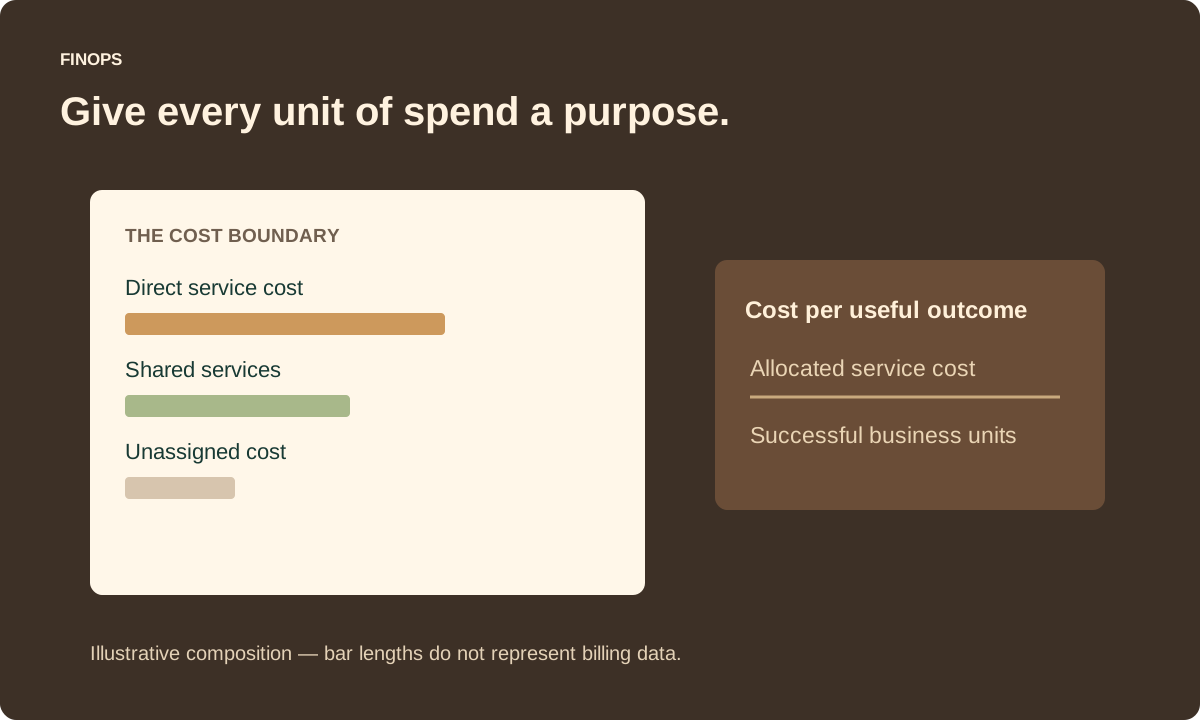
For a first pass, our recommendation is to identify direct costs, shared costs and costs that remain unassigned. Publish the exceptions rather than hiding them inside a convenient team’s total. Every material unassigned item should have a follow-up owner.
Document how shared services are distributed. A fixed split may be easy to administer; a usage-based split may be more informative. The useful choice is one stakeholders understand and can review when consumption changes.
2. Choose a unit that represents useful work
The Foundation’s unit-economics guidance connects technology consumption and cost to organizational value. Resource metrics and business metrics answer different questions: cost per gigabyte describes resource efficiency, while cost per completed customer workflow speaks to a business activity.
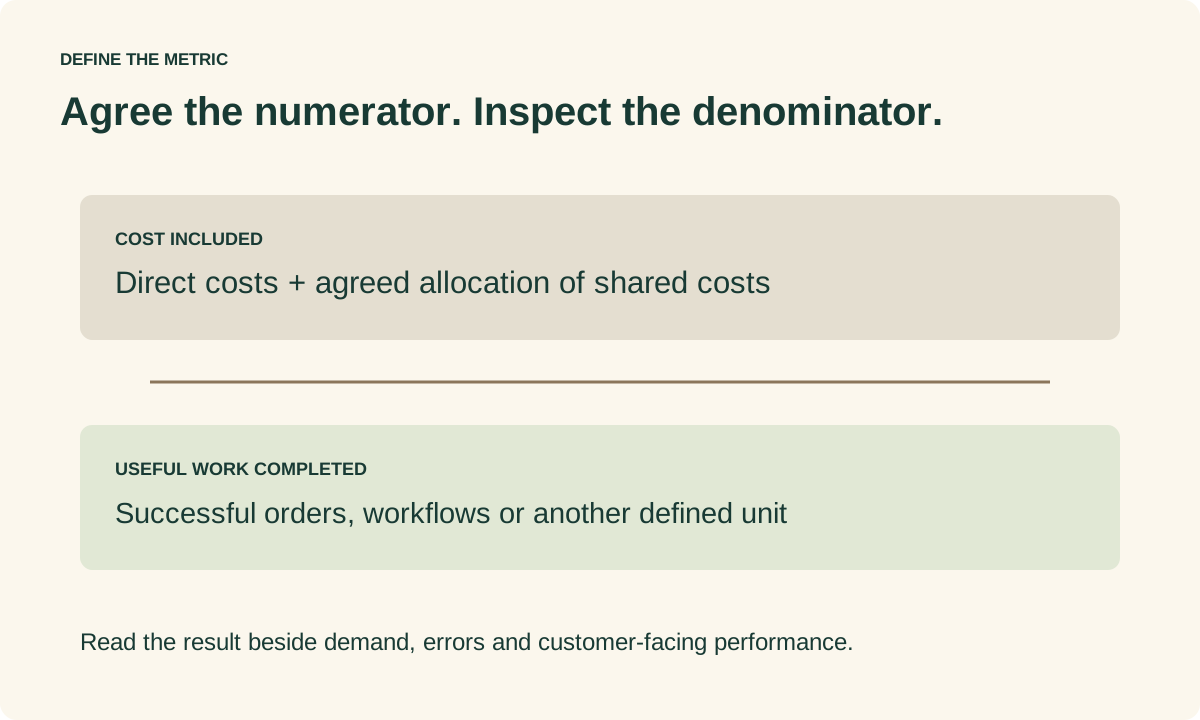
A practical starting formula is allocated cost for a period divided by successfully completed business units in that period. Choose a denominator that reflects the service’s purpose. Raw requests can include retries, failures and automated traffic that create expense without the same value.
Keep the reporting boundary visible. If database and support costs are excluded, label the metric accordingly. Do not compare it with another team’s fully allocated number and infer that one architecture is inherently more efficient.
3. Read the metric beside service quality
Unit cost is useful when it helps explain a decision. Pair it with demand, error rates, latency and a quality measure relevant to the product. Otherwise, dropping expensive but valuable work may appear to be an optimization.
Review changes over a consistent period and annotate unusual events such as a migration, large backfill or seasonal peak. Avoid interpreting a temporary shift in workload mix as a lasting improvement. Keep the source data reproducible so engineering and finance can reconcile the result.
4. Distinguish less consumption from a lower rate
Rate optimization concerns the commercial price paid for consumption. Usage optimization concerns how much is consumed and whether that usage is useful. The Foundation treats them as interdependent capabilities; purchasing a discount does not by itself remove waste.
- Does the resource still perform useful work?
- Can capacity or retention be reduced without breaking a service requirement?
- Is stable demand well understood before a long-term commitment?
- Who will check that the proposed improvement appears in operating data?
Before making a commitment, our recommendation is to examine utilization history, workload stability and the consequences of demand changing. After a technical change, confirm that the invoice or amortized reporting reflects the expected effect.
Run one decision-focused cost review
Pick one product and publish a cost boundary, allocation method, denominator and owner. Use the next review to decide on one measurable change. A smaller, explainable metric is more valuable than a large dashboard nobody uses.
Framework concepts are attributed to the FinOps Foundation. The workflow and wording here are original worqcloud editorial analysis; see the Foundation’s CC BY 4.0 attribution guidance in the references.