
Cloud adoption strategy: what to decide before you migrate
Turn cloud ambition into a funded, measurable plan—with clear workload choices, operating responsibilities and a first decision you can defend.
Article in brief
A useful strategy makes the next decision easier
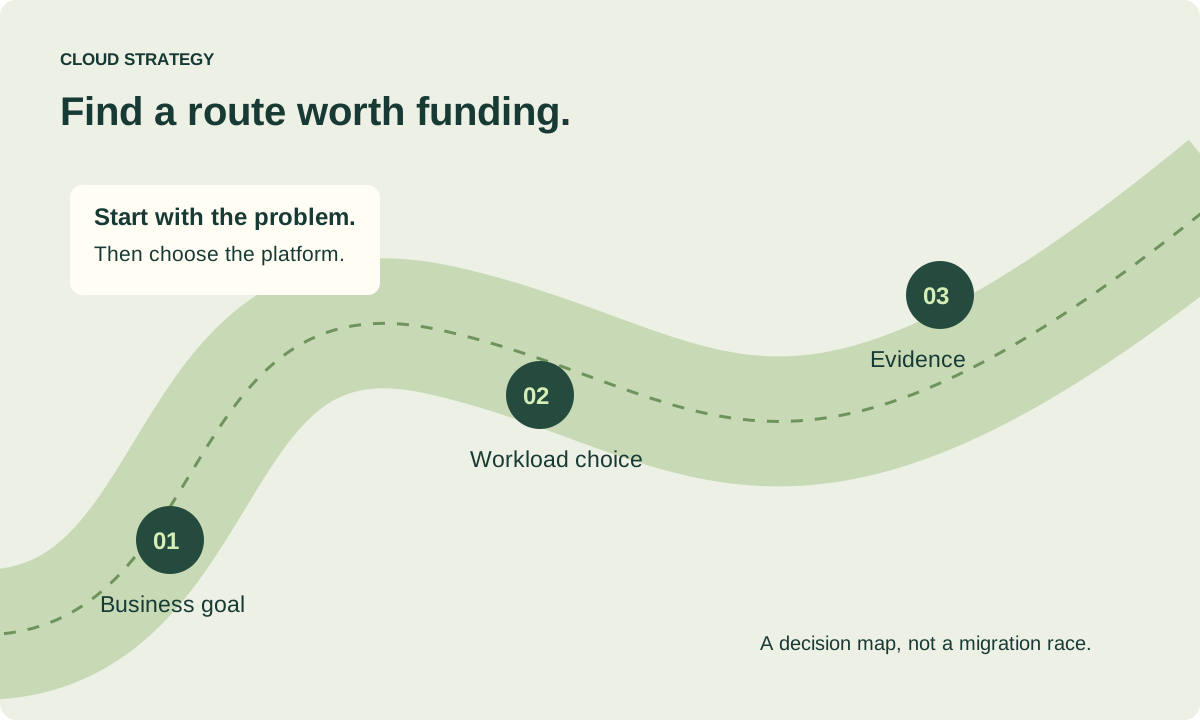
A migration target tells you how much infrastructure might move. It does not tell you which customer problem will improve. Start with the service people depend on: an application that cannot handle demand, a slow release process or a recovery procedure nobody has tested.
Microsoft’s Cloud Adoption Framework treats adoption strategy as a connection between business objectives, organizational readiness and investment choices. That is the source-backed foundation for this guide. The meeting prompts and pilot checklist below are worqcloud’s suggested way to put it into practice.
1. Choose an outcome and define its boundary
Pick one outcome a business owner is prepared to fund. Record the current measurement, the target and the date of review. Keep the definition narrow enough that the team can explain how a technical change would affect it.
For faster releases, distinguish development time from approval delays and deployment time. Moving the application will not automatically fix a manual approval process. For better recovery, define acceptable downtime and data loss before selecting a topology.
Bring the product owner, operations lead, security representative and finance partner into that conversation. Ask which trade-off each will accept, rather than collecting four independent wish lists.
2. Decide what each workload actually needs
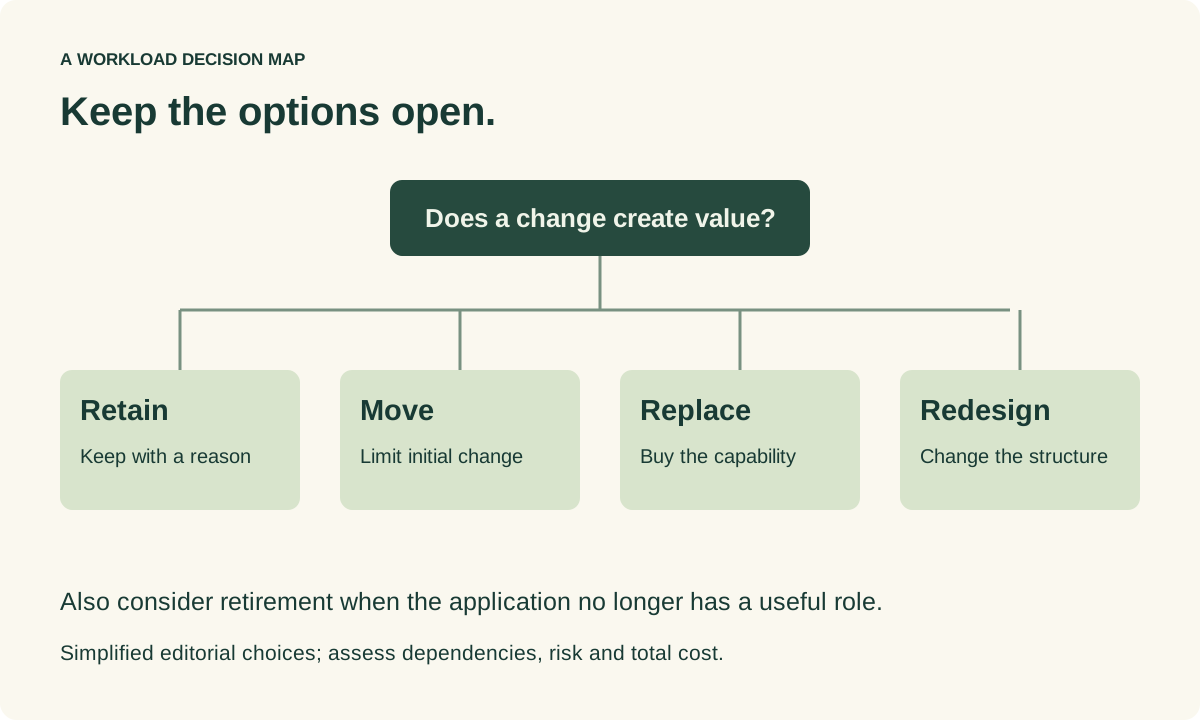
AWS describes seven migration approaches: retire, retain, rehost, relocate, repurchase, replatform and refactor or re-architect. They are alternatives to assess, not a maturity ladder where every application must eventually be rewritten.
Our recommendation is to record the decision and its conditions together. Retaining an application can be sensible while a dependency is understood; replacing one can be attractive until integration or data-export requirements change the business case.
Inventory the data flows, licenses, owners and upstream systems before committing to a migration wave. Group applications by dependencies as well as by department. A small front end may still depend on a shared database that makes its cutover difficult.
3. Include the cost of running the new service
Compare options over the same planning period and at similar service levels. Include migration effort, overlapping environments, connectivity, support and the work of retiring old infrastructure. A compute estimate alone is too small a boundary for an investment decision.
Make uncertainty visible. Show what happens if the migration takes longer or traffic is higher than expected. Avoid presenting a single point estimate as a guaranteed saving. Record who can approve a budget change and what evidence they will receive.
4. Use a pilot to test the operating model
A useful pilot is a bounded service with a real owner and observable demand. It should teach the team something about deployment, access, cost and recovery without exposing the most critical transaction to unnecessary first-time risk.
- Can we deploy and reverse a change using a reviewed procedure?
- Can we meet the agreed recovery and performance targets?
- Can the named team operate the service within the approved cost envelope?
Before launch, write acceptance and rollback criteria. After launch, ask whether the team can interpret alerts, restore data and account for the bill. Those are suggested decision gates; a universal 90-day deadline would ignore procurement, integration and organizational constraints.
Take one page into the review
Summarize the outcome, chosen workload, migration approach, cost assumptions and accountable owners on one page. End with the next decision date. Attach operational evidence rather than expanding the strategy into a catalogue of services.
Revisit the plan when demand, constraints or priorities change. A strategy earns its place when it helps a team approve, revise or stop an investment with clear reasons.