
When is Lambda provisioned concurrency worth paying for?
Separate initialization from application and dependency delay, compare prepared-capacity windows, and build a repeatable cost-performance decision for one important route.

A fast function can still have a slow first response
A small API function may complete its business logic quickly while the first request after a quiet period feels slow. The difference can come from work that happens before the handler is ready, from a downstream connection, or from another part of the request path. Buying pre-initialized capacity before separating those causes can solve the wrong problem.
This guide uses a fictional appointment-availability API. People browse available times during the day, a marketing campaign produces a short burst, and a nightly job uses a separate function. All measurements, demand shapes, and proposed decisions are illustrative. They are not customer results or quoted AWS performance guarantees.
AWS documents provisioned concurrency as a way to prepare execution environments ahead of invocations. Its configuration and billing rules matter to the decision, but they are only part of it. The editorial framework here asks when the user experience needs that preparation, how much capacity to test, and how to verify that the benefit is worth its cost.
The outcome should be an explainable service choice. A team should know which route needs predictable startup, which demand window it is protecting, what happens beyond prepared capacity, and how it will notice when the setting stops matching the workload.
Name the user journey that needs predictable latency
Start with a specific request rather than a service-wide statement that cold starts are bad. A user waiting for available appointment times may have a different tolerance from a background reconciliation job. Both can use Lambda while needing different operating choices.
Write down the end-to-end latency objective for the availability journey and identify where the function sits. Include the browser, network, gateway, function, database, and any external dependency. A faster startup is useful only to the extent that it improves the user-visible outcome you care about.
Decide which part of the distribution matters. An average can hide a small but important set of slow requests. A high percentile can also be misread when the sample is tiny or the traffic mix changes. Use measurements appropriate to the route and report the conditions under which they were collected.
For the fictional API, the team might care most about the first request after a quiet period and the start of a scheduled campaign. That gives the experiment a concrete focus. It also leaves room to decide that a nightly task should continue using ordinary on-demand execution.
Separate initialization from handler and dependency work
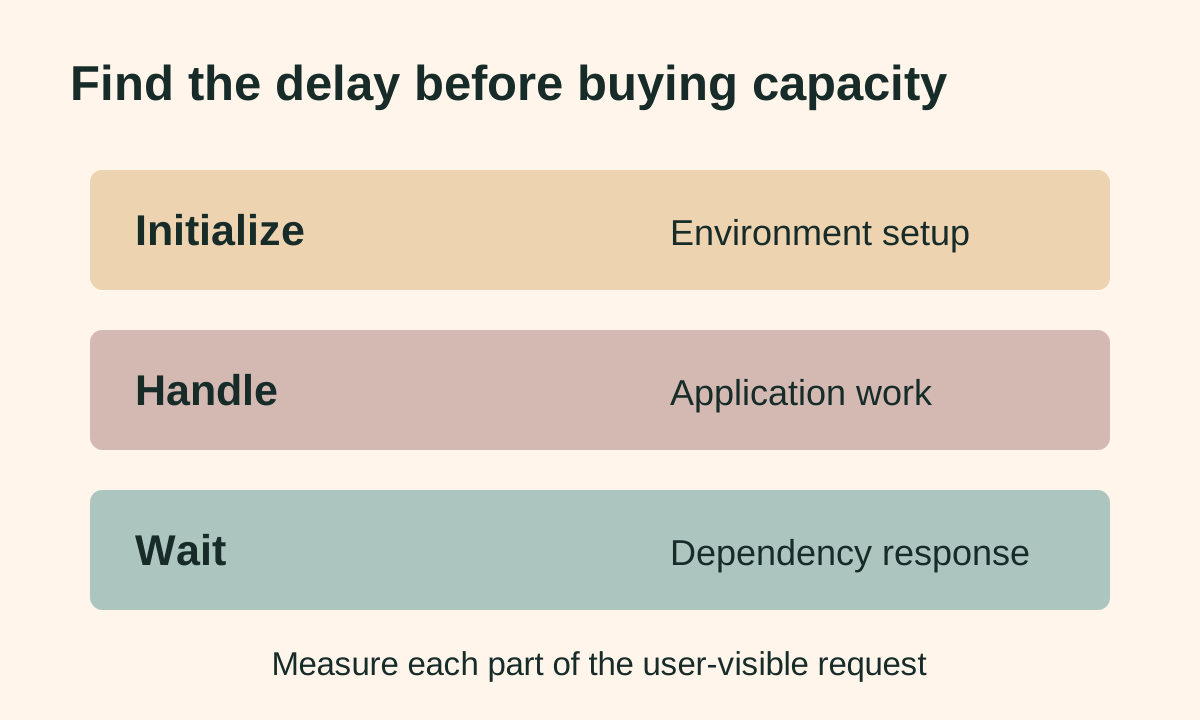
Inspect the function's startup and invocation evidence using the supported logging and monitoring options for its runtime. Identify work performed while the execution environment initializes, work performed inside the handler, and time spent waiting on dependencies. These are different optimization opportunities.
A function may import a large dependency graph, load configuration, construct clients, or initialize runtime components before useful work begins. It may also defer a connection until the first handler call. Prepared environments can change some startup behavior while leaving lazy work in the request path.
For the availability API, compare a first request with later requests under a controlled workload. If both are slow when the database is overloaded, provisioned concurrency is unlikely to address the dominant delay. If initialization accounts for much of the difference, it becomes a candidate worth testing.
Avoid labeling every first-request delay a cold start without evidence. A cold browser cache, gateway behavior, name resolution, or a remote service can contribute. The cost decision becomes clearer when the team can point to the stage it expects to improve.
Understand what prepared capacity actually provides
Provisioned concurrency prepares execution environments for a configured function version or alias. The linked AWS documentation explains the supported configuration and lifecycle. The function still executes its handler and calls dependencies, so prepared capacity is not a guarantee that every application operation will be fast.
Apply the setting to the exact invocation path used by the caller. A team can configure capacity on one alias while the API integration invokes another version or the unpublished function. In that situation, the console setting and the request path describe different targets.
Document the prepared capacity as a number of execution environments, not a monthly request allowance. Concurrency concerns work in progress at the same time. A large number of short requests spread over a day can need less concurrent capacity than a smaller burst of slow requests.
Review what happens when demand exceeds the prepared amount. The relevant behavior depends on the function's concurrency configuration and service limits. Test that boundary directly so operators understand whether additional traffic uses other available capacity, encounters throttling, or experiences startup behavior outside the protected portion.
aws lambda get-provisioned-concurrency-config \
  --function-name appointment-availability \
  --qualifier production

aws lambda get-alias \
  --function-name appointment-availability \
  --name production
Read-only inspection examples for an existing function and alias. Use the appropriate account, region, permissions, and real target names. Compare the returned alias target with the version used by the caller.
Distinguish reserved concurrency from provisioned concurrency
Reserved concurrency and provisioned concurrency serve different purposes. AWS documents reserved concurrency as a control over a function's concurrency allocation and limit, while provisioned concurrency concerns pre-initialized environments. A setting that reserves capacity does not by itself mean those environments are already prepared.
Use the terms precisely in the runbook. If someone says the function has concurrency set to ten, ask which control they mean and on which version or alias it applies. Ambiguous language can lead to a configuration that passes a review while failing the intended latency requirement.
For the appointment API, the team may want both a predictable prepared portion and a deliberate ceiling that protects a downstream database. Those goals can interact, so review the supported limits and relationship in AWS documentation. Do not copy a pair of values from an unrelated workload without checking their effect.
Test an overload case in a sandbox. Observe the function metrics and the client-visible response while the downstream service remains protected. Prepared capacity should be part of a complete traffic and dependency plan, rather than an isolated performance switch.
Measure concurrency instead of guessing from daily traffic
Daily request totals are useful for understanding business scale but weak as a direct sizing input. A thousand requests spread evenly across a long period differs from a thousand requests arriving together. Duration also matters because a request that waits longer occupies execution capacity longer.
As an illustrative estimate, a steady arrival rate of twenty requests per second with a mean in-flight duration of one quarter of a second suggests about five concurrent requests on average. This arithmetic is a starting model under stable conditions, not a guarantee about peaks or tail behavior.
Inspect observed concurrency and duration around the actual demand windows. Include burstiness, retry behavior, and slower dependency responses. A capacity choice based only on a quiet-day average can fail at the moment the business expected it to help.
Record the assumptions with the estimate. For the availability API, the campaign may include a concentrated first minute and a different mix of queries from ordinary browsing. Use representative load and inspect the measured result before selecting production settings.
Build a baseline that can be compared honestly
Capture the current function version, memory configuration, deployment package, runtime, alias, and dependency conditions. Keep the test request set stable and distinguish first-use observations from later invocations. A baseline without configuration context is difficult to reproduce after the application changes.
Measure end-to-end response time as well as function-side evidence. The user experiences the entire request path. If a local benchmark omits the gateway and database, it may exaggerate how much prepared execution changes the real journey.
Use an isolated or authorized test environment with bounded load. Keep test records and external effects separate from production business activity. A performance experiment should not create real appointments, send customer messages, or overload a shared dependency.
Retain the raw observations and a short explanation of the test. Report the number of requests, demand shape, relevant timing windows, and known limitations. That allows a reviewer to distinguish an observed improvement from a confident claim based on a handful of favorable requests.
Fix avoidable startup work before buying around it
Inspect work done during initialization and decide what is necessary for every request. Large imports, unused modules, repeated configuration reads, and unnecessary setup can add overhead. The correct changes depend on the runtime and application, so measure each candidate rather than assuming a smaller package always produces a proportional improvement.
Keep safe reuse where the runtime and client libraries support it. Recreating a client on every request may move work out of initialization only to repeat it inside the handler. The aim is to reduce useful work per invocation and startup delay, not merely make one timing field look better.
For the appointment API, suppose a library used only by a rare export route is imported into the common availability function. Separating those responsibilities may simplify the common path. That is an illustrative design option requiring its own deployment and maintenance review.
After each change, repeat the baseline workload. Confirm both correctness and latency. A startup optimization that breaks configuration refresh, request isolation, or dependency behavior can be more expensive than the delay it removed.
Check whether memory changes the cost-performance balance
Lambda memory configuration affects more than the amount of memory available. AWS documents the relationship between memory allocation and compute resources. A workload can sometimes complete faster at a different memory setting, but the result depends on whether it is constrained by compute, memory, or external waiting.
Test several supported settings with the same request set and dependency conditions. Compare duration, errors, resource behavior, and estimated cost. Do not infer the best point from a single setting or assume that the smallest memory allocation is the cheapest useful configuration.
For an API dominated by a database wait, more compute may have little effect. For a function doing significant parsing or computation, the trade-off may be different. The measurement should identify which part of the workload changes and whether the end-to-end user experience improves.
Include the prepared-capacity cost in the final comparison if provisioned concurrency remains a candidate. Changing memory can affect both execution characteristics and the cost of configured capacity. Evaluate the complete scenario rather than combining the best latency number from one test with the cheapest price assumption from another.
Treat SnapStart as a separate option to evaluate
AWS offers SnapStart for supported runtimes and configurations to reduce initialization latency through a different mechanism. Its compatibility requirements, restrictions, restore behavior, and pricing should be checked in the current documentation. It is not a universal substitute for prepared capacity in every function.
Start with applicability. Confirm whether the runtime, architecture, deployment arrangement, and function features are supported. Then review application assumptions about initialization, uniqueness, connections, and state that may need attention under the documented restore model.
For the appointment API, compare eligible options using the same end-to-end workload and business objective. The question is which supported design meets the latency need at an acceptable operating cost. A feature comparison detached from the actual function can produce a confident but irrelevant recommendation.
Keep each experiment separate. If you change runtime behavior, memory, package structure, and concurrency settings at once, you may not know which factor produced the outcome. A clear comparison makes later maintenance easier when pricing, demand, or runtime support changes.
Price the protected window, not an imagined perfect month
Prepared capacity incurs charges while it is configured according to the service's current pricing rules. Function execution and other services also contribute to the bill. Use the AWS pricing page and the region, memory, duration, and architecture relevant to your function instead of embedding a universal dollar figure in the decision.
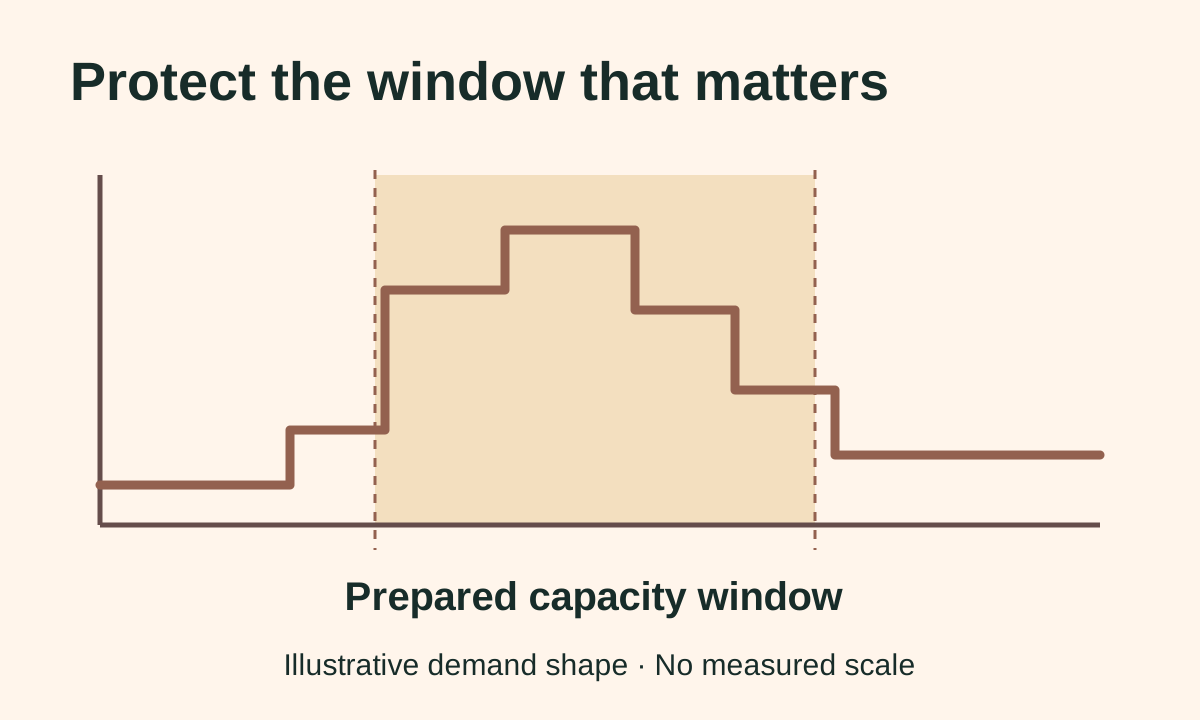
Define the window the business actually needs to protect. A scheduled campaign may need prepared capacity for a bounded period. A continuously used interactive endpoint may have a different justification. The comparison should state when capacity is active and how the team will ensure it is ready in time.
List the cost components separately. Include configured capacity, invocations, execution duration, logs, network activity, and relevant downstream capacity. This makes it possible to see whether the proposed change saves effort, improves experience, or simply shifts cost from one line to another.
For an illustrative worksheet, compare on-demand operation, prepared capacity during the campaign, and prepared capacity all day. Leave the rate cells linked to current regional pricing. The most useful output is an understandable break-even discussion, not a precise-looking total built from assumptions nobody reviewed.
Compare value with a measurable business outcome
A lower first-response time can be valuable, but the team should explain why. The availability API may reduce abandonment, support a contractual response target, or make a launch more predictable. Those are hypotheses to measure, not automatic outcomes of a concurrency setting.
Choose a business or user-experience measure that can be observed without confusing correlation with causation. Completion rate, user-visible latency, and support reports can contribute. Demand mix, campaign content, and other releases can affect the same measures, so document what changed during the comparison.
Use a bounded decision when evidence is incomplete. The team can fund prepared capacity for an important event, observe the outcome, and review whether to retain it. That is more honest than claiming a universal return on investment before the first representative rollout.
Record who owns the trade-off. Product may decide how much latency matters, engineering measures the effect, and finance helps interpret cost. A decision shared across those roles is easier to revisit when the workload becomes quieter or a dependency becomes the dominant bottleneck.
Schedule capacity with enough readiness time
A scheduled increase needs time to become usable under the service's documented behavior. The job that requests the change and the moment the application is protected are not necessarily identical. Review allocation status and plan the schedule around the actual readiness requirement.
For the fictional campaign, define the start of expected demand and the time when prepared capacity must already be ready. Include a check before opening the campaign traffic. The exact lead time should come from observed behavior and supported service controls, not an arbitrary number in a generic guide.
Plan the reduction as well. A campaign may end later than expected, or a batch of retries may arrive after the visible peak. Choose a reviewed policy for scaling down and inspect whether it exposes a meaningful tail of user requests to different startup behavior.
Keep schedule ownership clear. If marketing changes the launch time, the team responsible for capacity needs a reliable signal. A technically correct schedule attached to an outdated business calendar can miss the window it was created to protect.
Understand the limits of reactive scaling
A reactive controller responds to observed demand, which means a sudden burst can arrive before additional prepared capacity is available. That does not make reactive scaling useless. It means the team should understand the delay and combine it with demand knowledge where appropriate.
Measure the arrival shape and the scale response. A gradual daily rise differs from a campaign that begins with many users opening a link at once. Use a representative burst in the test environment and inspect which invocations use prepared capacity and which do not.
For a predictable event, a scheduled baseline may complement reactive adjustment. For unpredictable demand, the business may accept a mixed experience or fund a different baseline. The correct choice depends on latency requirements, cost, and the rest of the system's ability to absorb traffic.
Document what operators should do when demand exceeds the expected shape. The runbook should identify the relevant metrics, downstream limits, and approval path for a temporary change. Increasing function capacity without checking database or external-service capacity can move the bottleneck rather than resolve it.
Inspect spillover and throttling as different signals
A request served outside the prepared portion and a throttled request are different conditions. AWS exposes concurrency-related metrics that help distinguish behavior. Review the metric definitions for your function and configuration rather than using a single chart labeled capacity as the complete explanation.
For the appointment API, correlate prepared-capacity use, spillover-related observations, throttles, duration, errors, and user-visible latency. A brief spillover event may have little user impact, while a small number of throttles on an important route can matter significantly.
Look for alias and version mismatches before changing the capacity number. If the caller is invoking the wrong target, more prepared capacity on the unused alias will not help. A deployment record should identify the target behind the gateway integration and the configuration being monitored.
Use a small incident example in the runbook. Show what the team expects to see when prepared capacity is exhausted, when the function reaches its concurrency limit, and when a downstream dependency slows. Distinguishable symptoms support narrower, safer responses.
Make deployment changes part of the experiment
A new function version or alias update can affect the prepared-capacity arrangement. Review how the release process configures and verifies capacity for the target version, and what happens while traffic moves. Follow the supported deployment behavior for the tools you use.
Include a deployment in the test plan rather than measuring only a settled configuration. The team needs to know whether a release temporarily changes startup behavior, whether the new target is ready, and whether rollback returns traffic to a properly configured version.
For the availability service, record the version, alias, prepared capacity, and release identifier together. If a latency regression follows a deployment, those links help distinguish application changes from an invocation-path mistake or a capacity allocation issue.
Avoid hiding deployment uncertainty behind a larger permanent capacity setting. If the workflow does not wait for the required readiness state or invokes the wrong alias, fix that behavior directly. Operational correctness is part of the performance design.
Protect downstream systems while improving startup
Faster or more abundant execution can increase pressure on databases, connection limits, external APIs, and queues. A function that starts quickly may reach a constrained dependency sooner. The user-visible result can still be slow or error-prone if the downstream system cannot absorb the work.
Map the dependencies and their supported concurrency or rate constraints. Use bounded load in the experiment and observe connection behavior, retries, and latency. Do not interpret function-side improvement as proof that the full service can safely handle a larger burst.
For the appointment API, an important test is a burst that repeatedly queries the same availability data while the database is under representative background load. A benchmark against an empty database can miss the condition that matters during a real campaign.
Choose controls that protect the service as a whole. That may involve caching, request shaping, a concurrency ceiling, or a different data-access pattern. Evaluate those options against the business journey rather than treating prepared execution as the only performance lever.
Test quiet periods and first use deliberately
A useful experiment includes more than sustained traffic. Observe what happens after a quiet period, during the first campaign requests, after a deployment, and during dependency recovery. These conditions can reveal latency components that a warm steady-state benchmark hides.
Keep the test sequence recorded. If one candidate receives a long warm-up and another is measured immediately, the comparison may favor the better-prepared test rather than the better design. State what warm-up, allocation readiness, and request history each result includes.
Use several representative request shapes. A small availability query and a large filter combination may exercise different code paths or lazy initialization. The team should know which requests the prepared-capacity decision is intended to protect.
Report outliers with context. One unusually slow response is a reason to investigate, not automatically a reason to buy a large baseline. Repeated patterns tied to a known stage provide a stronger basis for changing the operating model.
Rehearse rollback before the important event
Write down how to return to the previous function version and capacity arrangement if the experiment causes problems. Confirm that the rollback path has the required permissions and that the previous application remains compatible with the current data and dependencies.
For a sandbox rehearsal, deploy a deliberately identifiable revision and then restore the earlier version through the ordinary release path. Observe alias targets, capacity readiness, and client behavior. The purpose is to verify the whole operation, not merely that a console button exists.
Decide which symptoms trigger rollback and which call for a capacity adjustment. An application correctness failure should not be treated as an initialization problem. A downstream overload may need traffic control rather than another increase in prepared environments.
Keep the event owner informed about those decisions. A performance configuration is part of a product launch when it protects a launch journey. The business should know what the team can safely change during the window and what would require a pause or reduced service.
Record the result without inventing certainty
After the experiment, report the observed latency change, traffic shape, target configuration, and cost estimate or actual billing window. Distinguish measured values from assumptions and explain any missing data. A useful decision record can be modest and still be actionable.
If the result is mixed, say why. Prepared capacity may improve the first response while leaving peak latency unchanged because a dependency dominates. A schedule may protect the campaign but be too expensive for all-day use. Those are meaningful outcomes that support a more precise configuration.
Avoid extrapolating a short test directly into a guaranteed monthly saving or revenue increase. Demand, pricing, application versions, and external behavior can change. Use a scenario range and a review trigger where uncertainty matters to the decision.
Name the person responsible for the next review. A setting that was sensible for a launch can remain after the campaign ends simply because nobody owns its removal. Include capacity configuration in the service's ordinary cost and performance review.
Choose when to leave the function on demand
Some workloads do not justify prepared capacity. A background job may tolerate startup delay, an infrequent administrative request may have a manual alternative, or initialization may account for little of total latency. The decision should follow the service need rather than the availability of a feature.
For the nightly appointment reconciliation function, the team may accept a slower first invocation because the job's deadline is broad and its correctness checks dominate the workflow. That can coexist with prepared capacity on the interactive availability route. Different functions can have different answers.
Document the acceptable behavior so the choice is deliberate. If a future product change makes the administrative route customer-facing, revisit the decision. A recorded latency and cost boundary is easier to maintain than a blanket rule that every function must be warm.
The useful outcome is a portfolio of service-specific choices. Spend where predictable startup materially helps a user journey, optimize avoidable work where evidence supports it, and leave simpler execution paths in place where they meet the requirement.
A practical decision worksheet
Write one page containing the route, user-visible objective, observed initialization contribution, demand window, tested concurrency, chosen version or alias, dependency limits, and cost assumptions. Add the experiment result and the rollback method.
Then ask four questions. Does the evidence show that startup contributes meaningfully to the problem? Does the selected configuration protect the demand window? Can the rest of the service support the resulting work? Is the expected benefit worth the complete operating cost?
If any answer is uncertain, identify the smallest test that would resolve it. That might be a first-use trace, a burst rehearsal, a price comparison, or an alias verification. A bounded unknown is easier to act on than a broad statement that serverless latency is unpredictable.
Use the worksheet again after a major runtime upgrade, traffic change, or application redesign. Prepared capacity is a maintained operating choice, not a one-time badge of production readiness.
A worked launch review
Suppose the fictional appointment campaign begins at a known time and lasts for a few hours. The team has measured a first-use delay that materially affects the booking journey, while ordinary warm requests meet the objective. The test also shows that the database remains healthy at the planned burst level.
A bounded proposal is to prepare capacity before the campaign, verify readiness on the invoked alias, observe the actual demand and spillover signals, and reduce capacity after a reviewed end condition. The cost estimate covers that window and the existing execution charges.
The review should still consider failure. Who notices if the allocation is not ready? What happens if the campaign link launches early? Which metric distinguishes a cold-start symptom from a database slowdown? The launch plan needs answers before the team relies on the setting.
After the event, compare the observed user journey and bill with the proposal. Keep the configuration only if the evidence supports ongoing need. Otherwise, remove or reschedule it through the normal change process and retain the experiment record for the next launch.
Read an illustrative cost worksheet correctly
Consider three columns labeled ordinary execution, campaign-only prepared capacity, and continuous prepared capacity. Each column should use the same region, architecture, memory setting, request assumptions, and application version. If one column assumes a faster handler or a smaller memory allocation, show that as a separate tested change.
The worksheet's first row describes the protected user journey. The second states how long capacity is configured. The third records the prepared amount and its readiness check. Later rows include invocation and execution assumptions, observability costs, and any downstream change required to support the traffic. This makes the scope visible before anyone reads the total.
Now add uncertainty. What if the campaign starts early, lasts longer, or produces a much smaller audience? What if a dependency doubles the time each request remains in flight? Those changes affect the usefulness of the configuration and may affect capacity needs. A sensitivity discussion can be more valuable than another decimal place in the estimate.
The reviewer should be able to explain why one option is preferred without memorizing the rates. Perhaps campaign-only capacity meets the measured latency requirement while avoiding unnecessary quiet hours. Perhaps demand is too unpredictable for that schedule. Either conclusion needs the workload assumptions and an observed test, not just the cheapest spreadsheet cell.
Use a request ledger to investigate outliers
For a bounded test, assign each request a safe identifier and record its start time, route, response status, end-to-end duration, invoked target, and relevant function-side evidence. Keep personal information and credential material out of the ledger. The purpose is to connect observations, not collect complete customer payloads.
Group the ledger by the conditions being tested. First-use requests after a quiet period, requests during a burst, and requests after deployment can reveal different patterns. If a result is unexpectedly slow, follow it into the dependency evidence before assuming the prepared amount was too small.
For the appointment example, a long response may coincide with a slow availability query while the function's own initialization is unremarkable. Another may use an unintended alias. A third may occur outside prepared capacity. Those cases call for different changes even if they look similar on a single client-side latency chart.
Keep a small sample of those explanations in the decision record. They teach the next operator what the configuration can improve and what it cannot address. A cost-performance setting is easier to maintain when the team understands the reasons behind its outliers.
Define a stop condition for an unsuccessful experiment
Before enabling prepared capacity, decide what evidence would cause the team to end the trial. It might fail to improve the selected user journey, cost more than the agreed budget, or expose a downstream limit that requires a different design. Those are useful outcomes when they are recognized promptly.
Choose a review window that includes the demand shape of interest. An event-specific trial can be reviewed after the campaign and its trailing work. A daily interactive service needs a window that includes quiet periods and normal peaks. Avoid extending the trial indefinitely simply because no one scheduled the decision meeting.
If the result is negative, restore the previous configuration through the normal process and retain the evidence. Note which hypothesis was rejected. Perhaps initialization was too small a share of total latency, or the service rarely received enough relevant traffic to justify the protected window.
Use that learning to choose the next experiment. A query improvement, smaller dependency graph, caching strategy, or gateway review may offer a better return. The point of a controlled trial is to narrow the problem, including when the correct answer is to leave prepared capacity disabled.
Keep the operating decision current
A function can change substantially without a change to its name. A new runtime, larger dependency, different database query, or new traffic source can alter initialization and execution behavior. Include the prepared-capacity decision in reviews of those changes when they affect the protected journey.
Keep a compact record of the current purpose, target alias, configured window, owner, and last representative test. Link it to the release process so someone investigating latency can find the relevant version and settings quickly. The record should describe the current service, not an old launch that no longer drives demand.
Review unused windows and stale assumptions during ordinary cost checks. If the campaign ended or traffic moved to another route, prepared capacity may continue without delivering the original benefit. Removing an obsolete setting is as much a part of optimization as adding a justified one.
The next action is to make the decision reversible and visible. A measured reason to enable capacity, a tested way to roll it back, and an owner for review turn a performance feature into a manageable service choice.
Use a short review at the end of every protected event
After the campaign, compare the demand the team planned for with the demand it actually observed. Note when prepared capacity became ready, which target received traffic, and whether the important user journey met its objective. Keep the comparison tied to the tested application version.
Check the period after the visible peak too. Delayed retries, follow-up browsing, and staff activity may continue after the campaign owner considers the event finished. Use the observed pattern to improve the next schedule rather than assuming the first end time was correct.
Close the review with a configuration decision and an owner. The team may retain the schedule, adjust the protected amount, remove the setting, or investigate a different bottleneck. Recording that decision prevents a temporary experiment from becoming unexplained permanent spend.
Make the next test smaller and more decisive
When the result is unclear, resist adding more configuration at once. Choose one unanswered question, such as whether initialization dominates a specific request class or whether a caller uses the intended alias. Design a bounded test that can answer that question with visible evidence.
A sequence of small, reproducible experiments gives the team a better basis for spending than a single large load test with many simultaneous changes. The useful output is a narrower explanation of the user-visible delay and a practical next action.
Know what to ask before approving the spend
A reviewer does not need every runtime detail to make a good decision. They do need the user problem, the evidence that startup contributes to it, the protected demand window, the tested limit, and the recurring cost boundary. Ask for those items in plain language.
Challenge numbers whose units are unclear. Requests per day, concurrent executions, prepared environments, and billed duration describe different things. A capacity estimate becomes much easier to review when the author shows how arrival rate and observed duration relate to the proposed concurrent work.
Ask what would cause the team to change its mind. A quieter service, a faster startup after optimization, or a new downstream bottleneck can alter the trade-off. A good proposal includes a review trigger rather than defending the setting indefinitely.
Start with one important route and a reproducible test. Provisioned concurrency is worth paying for when the measured service benefit, operating behavior, and cost fit that route. The experiment should make that conclusion easier to explain to the next engineer and the person funding the service.