
Before building a developer portal, fix one deployment journey
Build a useful self-service path from observed developer work, with safe retries, clear ownership, diagnostics, cost responsibility, and a complete service lifecycle.

The portal can wait for one useful deployment journey
A developer opens an internal portal and sees a polished catalog, several templates, and a long list of services. To deploy a small change, they still ask in chat which account to use, copy a configuration from an old repository, wait for an environment, and find someone who remembers the logging setup. The portal is visible. The path to a working service is still fragmented.
This guide follows a fictional company trying to improve the first deployment of a small internal API. The company has several application teams, a shared cloud environment, and a platform group with limited capacity. The example contains no invented customer results. It is a design exercise for choosing and measuring one useful self-service path.
CNCF's platform engineering material emphasizes platforms as products for their users and discusses self-service capabilities. Backstage documents software templates as one way to scaffold work. Those sources provide concepts and tooling details. The sequence of interviews, experiments, service contracts, and review questions here is worqcloud editorial guidance.
The first goal is a developer who can take an approved application from repository to a usable test deployment with understandable ownership and feedback. If that journey becomes reliable, a portal can make it easier to find and repeat. A portal cannot by itself decide the missing permissions, service standards, or operating responsibilities.
Choose one user group with a recurring problem
Start with a team that performs a similar task often enough to learn from. New API services, short-lived review environments, or routine deployments may be candidates. Avoid beginning with every developer in the company, because different teams can have different workflows and constraints.
For the fictional company, select two application teams that deploy modest internal APIs. They share an approved runtime and similar access requirements, but currently assemble deployment configuration in slightly different ways. That gives the platform group a bounded set of users and a repeated task worth observing.
Ask the teams where they lose time and confidence. A complaint about deployment complexity might refer to missing access, unclear documentation, slow reviews, or unreliable environments. Those are different problems. A template can help some of them, but a form that generates YAML will not resolve an ownerless approval queue.
Name the initial user group, task, and expected improvement in one sentence. For example, an application engineer can create an approved test deployment without asking which configuration to copy. That statement is easier to test than a broad ambition to improve developer experience.
Watch the current path before designing a replacement
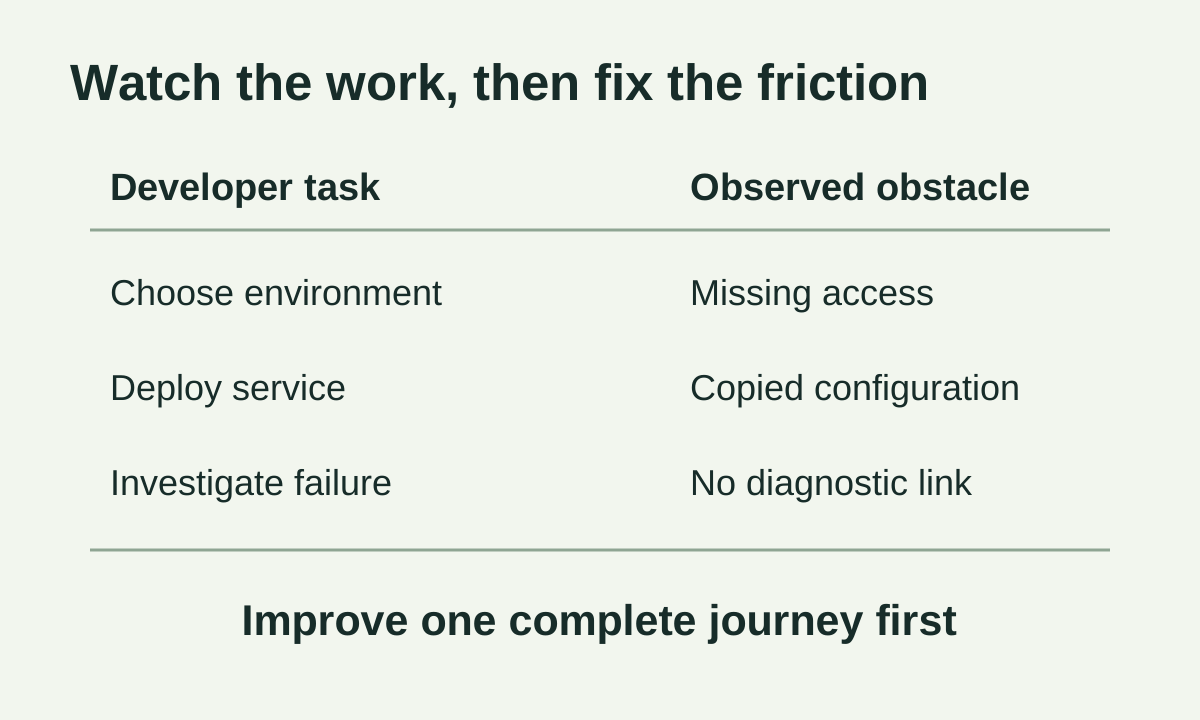
Observe a real, authorized deployment attempt from start to finish. Ask the developer to explain what they are trying to do, but avoid turning the observation into a guided demonstration where the platform expert solves each problem immediately. The friction is the evidence you need.
Record each handoff, lookup, approval, repeated entry, and uncertain decision. Note which steps require privileged access and which merely require missing information. Also record what happens when the happy path fails. A deployment journey includes error handling, not only the sequence that works for an expert.
For the internal API, the developer may spend little time running the deployment command but much longer finding the right environment values and ownership labels. That suggests a different first improvement from a faster build system. Follow the observed bottleneck rather than the tool the platform team most wants to introduce.
Keep the observation respectful and specific. The purpose is to understand the system the developer works within, not to score their skill. Share the resulting journey map with the participants and ask whether it represents their ordinary experience.
Define the starting and ending states
A journey needs a clear start and finish before it can be improved. Does it begin with an empty repository, an approved service request, or an application that already passes tests? Does it end with infrastructure created, a reachable endpoint, or a service that has monitoring and an owner?
For the first API path, choose a narrow but complete boundary. An approved repository with a minimal application enters the path. A test endpoint with health checks, logs, ownership, and a documented removal process exits it. This avoids claiming success when a scaffold exists but the developer cannot operate what it created.
List prerequisites openly. The user may need repository access, an approved namespace, a budget owner, or a supported runtime. A self-service path can have prerequisites, but they should be discoverable and testable before the user invests time in the workflow.
Record what the path does not yet support as a product boundary. A specialist data-processing service or a regulated production workload may need another route. The boundary should help users choose correctly and request an extension, rather than force them to discover unsupported behavior through a failed deployment.
Write the service contract before the template
Describe what the platform promises to create, what the application team owns, and which constraints apply. The contract should cover the environment, runtime assumptions, deployment inputs, access, observability, cost ownership, and support path.
For the fictional API, the platform might provide an approved deployment pipeline, a test environment, standard logging, and an endpoint pattern. The application team owns business logic, application health, and the declared service owner. The exact division depends on the company, but it must be understood by both parties.
Define failure feedback. If a requested name is invalid, a quota is unavailable, or an approval is missing, the user should know what happened and who can act. A workflow that fails with a raw cloud exception and no recovery route is only partially self-service.
Review the contract with security, operations, and finance where their controls are involved. The goal is to settle the supported path's boundaries once and encode them clearly, while retaining a process for exceptions. A template should implement that agreement rather than become the place where disagreements are hidden.
Offer useful defaults with a visible escape path
Defaults can reduce repeated decisions, but they need a reason. Choose settings that fit the initial user group's common workload and explain the important trade-offs. A default that is safe for a tiny test API may be inappropriate for a high-throughput service.
Separate essential policy from convenient convention. Some settings are required by access or data controls. Others are recommended starting points that a qualified team can change. Users should be able to tell the difference without reading platform source code or guessing which field is negotiable.
For the first API, a default test size, logging configuration, and naming pattern may be useful. A production topology or database choice may require a separate decision. Avoid making the first template appear universal by silently allocating infrastructure the user does not understand.
Provide an exception route with an owner and expected response. If every unusual need requires copying and modifying the template privately, the platform will accumulate unsupported forks. A visible path for requests helps the team learn which capabilities deserve product investment.
Keep the interface simple enough to use without a portal
A command, workflow dispatch, or small API can be a valid first interface if it delivers the complete journey. The user should not need a polished catalog to test whether the underlying path works. This lets the team learn about inputs, failure modes, and ownership before investing in presentation.
Choose an interface that matches the initial users' habits and access model. If they already work in repository workflows, a reviewed workflow entry point may be easier to adopt than a new portal login. If their task spans several systems, a small front end may help later.
For the fictional API path, start with a documented repository workflow accepting a service name and environment choice. Show the resulting endpoint, logs, and ownership record in its output. That gives the team a clear product slice to demonstrate and measure.
The interface should still have validation and usable feedback. A simple command that accepts arbitrary privileged input is not a well-designed product. Simplicity comes from a narrow contract and a coherent workflow, not from omitting the controls and support needed to operate it.
Make repeated requests safe
Users will retry when a browser refreshes, a workflow times out, or a status message is unclear. Decide how the platform recognizes an existing request and what it does when the same intended deployment is submitted again. Repeated execution should have an understandable relationship to existing state.
For the internal API, a stable service identity and environment can help locate the intended deployment. A new request should either update the supported resource, return its current status, or clearly explain a conflict. Creating a second environment every time a user clicks again can turn uncertainty into cost.
Test interruption after infrastructure exists but before the workflow reports success. Ask the user to retry using the documented path. Verify that the platform can inspect and reconcile partial state rather than requiring a platform engineer to delete resources manually.
Retain an operation identifier and a status view appropriate to the interface. The user needs to distinguish queued, running, completed, failed, and awaiting-action states. Those states make self-service credible because they explain progress even when the operation takes longer than expected.
Give every failure a next action
Collect the most common failure conditions from the observed journey. Missing access, invalid names, quota constraints, unsupported runtime versions, and application health failures each need different feedback. A generic deployment failed message leaves the user to recreate the platform team's debugging process.
For each condition, explain what failed, what remains in the environment, and what the user can safely do next. If the platform created partial resources, identify whether retry is safe or whether a cleanup or approval action is required. Good feedback reduces both user frustration and support load.
Keep sensitive internals out of broad error messages. A user may need an operation identifier and a clear owner rather than raw credentials, internal endpoints, or a full policy trace. Provide the deeper diagnostic evidence through the authorized support path.
Test messages with someone outside the platform team. Ask them to recover from a deliberately invalid input or failed health check using only the displayed guidance. Their next action is the best test of whether the feedback is useful.
Include observability in the first usable deployment
A reachable endpoint without a way to inspect failures leaves the developer dependent on another team. Include the basic logs, health information, and supported diagnostic links needed for the initial service type. Define how the application should emit the signals the platform expects.
For the API path, the workflow output can link to the service's health view and relevant logs. The application owner should know how to find a failed request and distinguish an application error from a deployment failure. The platform should explain which parts it monitors and which remain the team's responsibility.
Avoid collecting every possible signal by default without considering cost and data handling. Choose a useful baseline for the supported workload, then offer documented extensions. A standard that creates noisy, expensive telemetry can undermine adoption as quickly as missing diagnostics.
Exercise an application failure after deployment. Introduce a harmless test error, locate it through the supported tools, and recover through the normal release path. The journey is more complete when the developer can operate the service they just created.
Make ownership visible from the beginning
Every generated service should have an accountable application owner and a platform support relationship. Ownership is useful only if it can be found and kept current. A free-text label that nobody validates may look complete while pointing to a departed person.
Choose an ownership model that matches the organization. A team identifier with a maintained contact route can be more durable than an individual email. Record which team owns application incidents, which owns the deployment path, and who can approve cost or access changes.
For the fictional API, include ownership in the repository metadata and the service record produced by the workflow. Test whether an operator who sees the endpoint can find the responsible team. That makes the metadata operational rather than decorative.
Review ownership when services move, teams reorganize, or environments expire. A platform that makes creation easy but leaves responsibility unclear can increase the number of unsupported services. Self-service should include a maintained owner for the result.
Put cost responsibility into the path
Creating infrastructure is a spending action. The platform path should make the relevant owner, environment, resource class, and lifecycle visible. The exact estimate may vary, but users should understand whether they are requesting a small test service or a materially larger commitment.
Use approved defaults and supported limits to keep the first path bounded. For temporary environments, define an expiry or review process that the platform can actually enforce. A label saying temporary does not remove resources by itself.
For the API example, the request can identify a cost-owning team and a test environment class. The output should explain where to inspect usage and how to remove the service. If a request exceeds the supported class, route it through an explicit review instead of silently allocating more resources.
Measure whether users understand the cost feedback. A precise-looking estimate can be misleading when it excludes databases, network transfer, or logs. State the boundary and link to the organization's approved cost view. The product should improve accountability without pretending to predict every bill exactly.
Design the removal journey alongside creation
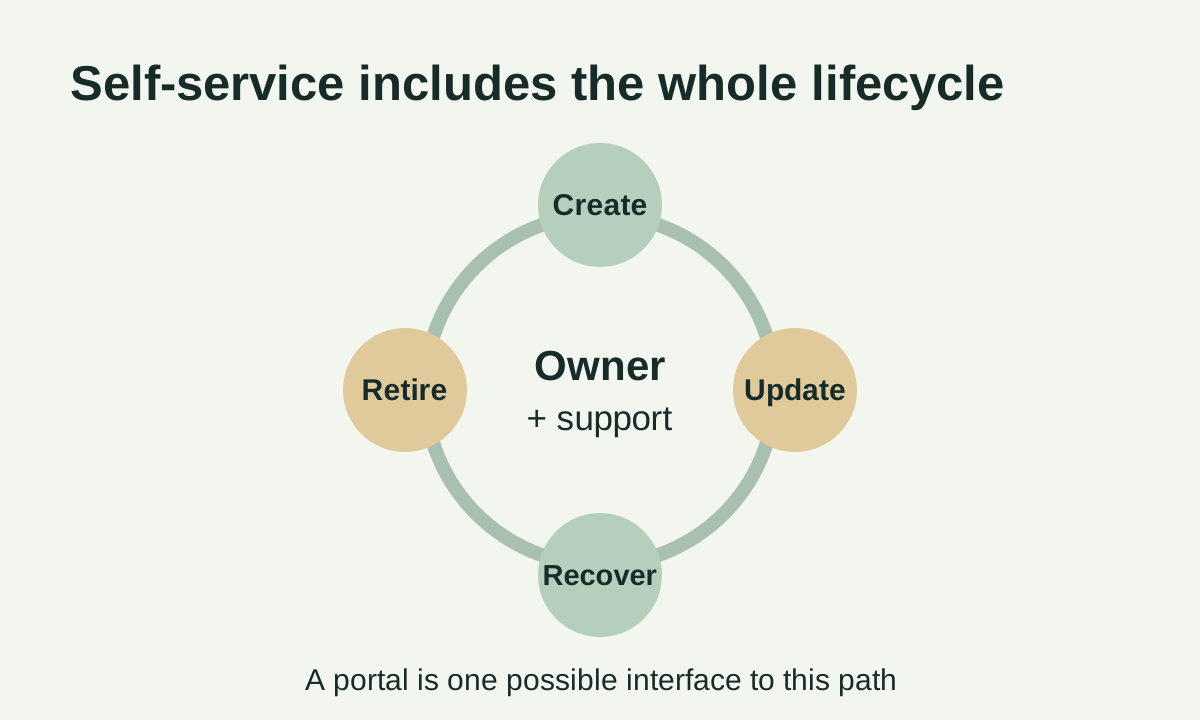
A service template is incomplete if nobody knows how to retire what it created. Define deletion or decommissioning behavior, data-retention checks, ownership approval, and the evidence that resources are actually gone. The process should distinguish disposable test infrastructure from data that needs a reviewed lifecycle.
For the internal API, test removal of an empty sandbox service first. Confirm that the pipeline, endpoint, service record, and associated infrastructure reach the intended state. Inspect for resources created outside the main deployment definition, such as manual credentials or diagnostic storage.
Explain what the platform will preserve. Logs, audit records, backups, or shared resources may follow separate policies. Users should not assume that deleting a service record removes every copy of its data, nor that every retained artifact is an orphan.
Include cancellation of a request that has not completed. A user who realizes they selected the wrong environment needs a safe path that accounts for partial work. Creation, retry, cancellation, and retirement are related parts of the product's lifecycle.
Treat the template as maintained software
A generated repository can outlive the version of the template that created it. Decide how fixes and improvements reach existing services. A template that is copied once and never updated may quickly produce a fleet of divergent deployment paths.
Separate generated starting material from shared components where appropriate. A shared workflow or module can centralize some behavior, but it also creates a release and compatibility responsibility. Users need to know which changes advance automatically and which require an explicit update.
For the API path, keep a template version in the generated service record and provide a supported upgrade route. Test the upgrade with an existing service rather than demonstrating only new creation. The installed base is part of the platform product.
Maintain examples that cover supported variants. A change that helps a new service should not quietly break a team using an older supported runtime or environment setting. The platform's own release process needs evidence, rollback, and clear communication.
Measure elapsed time and touch time separately
Elapsed time describes how long the user waits from the chosen start to the usable result. Touch time describes the effort people actively spend on the task. Both matter, and they can move in different directions. A faster automated command may leave a long approval wait untouched.
Observe a small number of real journeys before and after the change, with the same start and finish definitions. Record waiting, active work, support interruptions, and failed attempts. Avoid claiming a broad productivity improvement from one rehearsed demonstration by the platform's author.
For the first API, the platform may reduce time spent finding configuration while the cloud environment still takes the same time to provision. That can be a useful result because the developer can work on something else. Explain the actual improvement rather than forcing every benefit into one speed metric.
Include unsuccessful attempts in the review. A path that is fast when it works but frequently needs expert rescue may be worse for users than a slightly slower, dependable workflow. Reliability and recoverability belong beside timing.
Measure adoption with user tasks, not portal visits
A portal visit can show discovery, but it does not prove that the platform helped someone complete work. Track whether users start the supported task, reach the usable deployment, recover from errors, and return for their next relevant task. Keep the measurement consistent with privacy and internal data policies.
Ask why teams choose the old path. They may need an unsupported capability, distrust the failure handling, or simply be unable to find the new entry point. Each reason suggests a different product action. A mandate to use the portal can hide those distinctions without fixing them.
For the fictional company, interview both early adopters and teams that declined. Observe one successful self-service deployment and one abandoned attempt. The resulting evidence is often more useful than a large chart of page views.
Use adoption as feedback about fit. The platform team should learn which part of the journey is valuable and which constraints need improvement. A service that people use voluntarily for a recurring task has a stronger foundation than a catalog populated mainly to satisfy a reporting target.
Make the support path part of the product
Self-service does not mean users never need help. It means ordinary work has a supported path, errors are understandable, and assistance has a clear boundary. Publish where to ask, what information to include, and which team responds to platform versus application problems.
Use operation identifiers and sanitized diagnostics to reduce repeated questions. A developer should not need to paste a full secret-bearing log into a public channel to explain a failed request. The platform should make the relevant context available through the authorized support route.
For the API path, provide a short support template containing the service, environment, operation identifier, expected action, and observed result. Include a link from the workflow output. That turns support from an informal social network into a usable extension of the product.
Review recurring support cases as product evidence. If many users ask the same configuration question, improve the default, validation, or documentation. A platform team that counts tickets without feeding them back into the journey misses a major source of design information.
Include security in the supported path
A platform can make approved controls easier to use by building them into ordinary deployment behavior. Identity, artifact provenance, access boundaries, configuration handling, and service ownership should be part of the contract, with implementation reviewed by the responsible specialists.
Avoid turning the platform interface into a general-purpose privileged command runner. Validate inputs and constrain what users can select. A convenient form that passes arbitrary target identifiers into a powerful deployment role can expand access beyond the intended service boundary.
For the first API, test both an authorized request and an attempt to select another team's environment. The expected denial should be clear and should leave no partial resource behind. Use a sandbox arrangement and approved test identities for that exercise.
Explain the exception process. Some services will need different controls or access. A documented review route helps users obtain a supported solution instead of bypassing the platform through a private script. Security is more maintainable when the useful path and the approved path align.
Review the platform's own failure modes
The self-service path depends on its own systems: source control, workflow execution, state storage, cloud APIs, template registry, and any portal. Map those dependencies and decide how users see a failure in each one. A portal outage should not make the team's operational knowledge disappear.
For an existing service, ask whether ordinary deployment or incident response can continue if the creation interface is unavailable. The answer depends on the architecture, but it should be deliberate. A platform that centralizes every operation can become a significant shared dependency.
Test a failed backend call and a delayed workflow. Confirm that the user sees an accurate status and can safely retry or escalate. A spinning page without a durable operation record makes it difficult to know whether work is still running.
Keep recovery ownership and service objectives appropriate to the platform's importance. As more teams depend on it, the platform becomes an internal product with real operating obligations. Its reliability should grow with the critical tasks it supports.
Introduce a portal when discovery becomes a real constraint
A portal can be valuable when users need a consistent place to find services, templates, documentation, ownership, and operational links. Introduce it to solve observed discovery and coordination problems, with the underlying service paths already defined.
For the fictional company, a portal may become useful after several supported deployment paths exist and developers struggle to choose among them. The portal can present the right options, prerequisites, and status. It should not require the team to reinvent a reliable backend workflow merely to fit a polished interface.
Evaluate how the portal integrates with identity, permissions, catalog data, and existing tools. A duplicate ownership database or a manually maintained service list can become stale quickly. Decide which source is authoritative and how updates flow.
Test the complete task through the portal with real users. Can they find the right path, understand its boundary, submit valid inputs, inspect progress, and recover from failure? A successful portal launch is a better user journey, not simply a new navigation menu.
Give users a migration path from copied scripts
Existing teams may have working scripts with local improvements. Treat those as evidence of real needs rather than obstacles to standardization. Identify which differences are necessary, which are accidental, and which reveal a gap in the proposed platform contract.
Offer a bounded migration for one existing service. Preserve the application's required behavior, compare deployment outputs, and rehearse rollback. The platform should earn trust by making ordinary work easier to explain and operate, not by asking users to discard a known path without evidence.
For the API example, map the old script's environment values, identity, artifact process, and health checks to the supported workflow. Record any unsupported behavior before the change. That prevents a migration from quietly removing a capability the team relies on.
Keep an exception until its replacement is validated, with an owner and review date. Permanent undocumented forks are hard to support, but a forced migration that breaks service operation creates a different problem. Use concrete acceptance criteria to move from one path to the other.
Prioritize the next capability from observed demand
After the first journey works, collect the next set of recurring needs. Rank them by user impact, frequency, current support effort, implementation cost, and fit with the platform's operating capacity. Avoid selecting the next feature solely because another company has it in a public platform diagram.
For the fictional company, the strongest next request might be a review environment, a database attachment, or an upgrade path for the existing API template. Each option has different lifecycle and security consequences. Scope the next slice as carefully as the first.
Look for repeated exceptions that share a stable pattern. Those can indicate a useful extension. A collection of unrelated one-off requests may instead need specialist consultation or a separate path. The platform does not need to absorb every cloud task to provide value.
Publish the prioritization reasoning. Users are more likely to trust a roadmap when they can see which problems it addresses and what evidence informed the choice. A transparent backlog also gives the platform team a way to say when a request needs more discovery.
A worked first-release plan
Choose one application team, one supported runtime, and one test environment class. Observe the current journey, write the platform contract, and implement the smallest interface that produces a usable deployment with logs, ownership, and removal instructions.
Ask a developer who did not build the path to create a service, make a small update, diagnose a harmless health-check failure, retry an interrupted operation, and retire the service. Record the time, support requests, and any unclear state. These tasks exercise the lifecycle rather than a single happy-path screenshot.
Review the findings with the user team and the control owners. Fix the most consequential gaps before inviting more teams. The first release can be narrow and still be complete for its intended use. Expanding an unclear path multiplies support work.
Once the journey is reliable, make it easy to discover through the tools users already use. Add a portal when that interface solves an observed problem. The sequence keeps the platform's value tied to a task someone can complete.
Use a concrete acceptance script with a new user
Give a developer a small approved API and the supported path's entry point. Ask them to deploy it to the test environment without verbal guidance from the platform author. Observe what they read, which choices they make, and where the interface leaves them unsure.
The acceptance script should include a normal creation, a small update, a deliberately invalid service name, an interrupted request, and removal of the test service. Each task has an expected state and a recovery route. This is more informative than asking whether the developer likes the portal.
For the invalid name, the platform should reject the request before unnecessary resources are created. For interruption, the developer should be able to find the operation and determine whether retry is safe. For removal, they should understand which data and shared resources follow separate retention rules.
End with a short interview about the decisions the user had to make. Ask which parts felt trustworthy and which still required social knowledge. Translate those observations into specific changes rather than a general statement that the experience needs polish.
Compare two interface proposals using the same journey
Suppose one proposal adds a portal form while another improves the existing repository workflow. Run the same acceptance script through each prototype with a small, representative user group. Keep prerequisites and backend behavior comparable so the test focuses on the interface and discovery problem.
The portal may make options easier to find and explain. The repository workflow may fit the team's ordinary release habits and provide clearer version history. Neither advantage establishes that the full journey is better. Inspect task completion, error recovery, support requests, and confidence in the resulting state.
Include the operating cost of each interface. Someone must maintain authentication, permissions, template compatibility, documentation, and support. A small convenience for users can still be worthwhile, but the platform team should understand what commitment it creates.
Choose the proposal that improves the observed task at a sustainable cost. If the evidence is inconclusive, identify the uncertainty and a smaller next test. The decision should follow the user journey rather than a preference for a particular product category.
Make success evidence portable across teams
A good first release produces evidence another team can inspect. Keep the supported workload, prerequisites, measured task boundaries, observed failures, and completed fixes together. Include the exact template or workflow revision so the demonstration can be repeated.
Avoid reporting only the fastest successful user. Show the range of observed attempts and explain where expert help was needed. A path that works after its author supplies several undocumented values is still valuable as a prototype, but it is not yet evidence of independent self-service.
For the fictional API, the evidence might include a developer-created endpoint, a successful update, an understood health-check failure, a safe retry, and confirmed teardown. Those outcomes tell a new team what the platform can do without promising that every workload is already supported.
Use the record during onboarding. Let the next team compare its needs with the supported boundary and identify differences early. This keeps expansion grounded in demonstrated capability and makes exceptional requirements easier to discuss constructively.
Plan the first month of ownership
After launch, reserve time for support, defect fixes, documentation updates, and review of actual user attempts. A platform path is a maintained service, not a project that ends when the initial template is merged. Early operating work is part of learning whether the product fits.
Name who reviews failed operations and how often. Distinguish a platform defect from an application health problem and an unsupported request. The categories should lead to useful ownership, not become a way to redirect users between teams without resolution.
Review costs and abandoned resources during the same period. The first users may expose lifecycle assumptions that the prototype did not cover, such as cancelled requests or environments created for a demonstration. Fix the underlying path rather than cleaning up each case manually forever.
At the end of the month, choose a concrete next decision. Expand to another team, improve the current journey, add a recurring capability, or narrow the supported boundary. The evidence should make that choice easier than it was before the first release.
Keep the user's goal visible in the roadmap
A platform roadmap can drift toward a list of integrations because integrations are easy to name. Translate each item back into a task a user can complete. A catalog connector should improve discovery or ownership freshness. A new template should support a recurring workload with a clear lifecycle.
Ask what becomes easier after the capability exists and how the team will verify that improvement. If the answer is only that another system appears in the portal, the user problem may need more discovery. The platform's value comes from the task and its operating outcome.
Keep one measure of user effort and one measure of reliability for the chosen journey. They do not need to be elaborate. Consistent observation of complete tasks can be more useful than a large collection of interface metrics with no decision attached.
The first successful deployment path becomes a reference for that discipline. It shows the organization how to turn a repeated cloud task into a supported product slice with visible responsibility, safe recovery, and evidence that users can complete it.
Revisit the first journey after the second team arrives
A second team often reveals assumptions the first team already knew. Watch its first attempt and compare the questions with the original observations. A naming convention, access prerequisite, or support route may have seemed obvious only because the first users helped design it.
Fix those gaps in the supported path rather than sending each new team a private onboarding message. Shared documentation and validation should carry the knowledge that users repeatedly need.
Keep the product boundary visible as adoption grows. The platform can expand deliberately while preserving an understandable promise for each supported journey. That is how a useful first workflow becomes a dependable internal service.
Keep the product boundary understandable
A supported path should tell users what it does, who it is for, what they need before starting, and where to go when their need differs. That clarity reduces both accidental misuse and unnecessary support. It also gives the platform team a manageable commitment.
Review the boundary as the organization changes. A test-only API path may later be asked to support production, sensitive data, or a new runtime. Treat those requests as product and operating changes with explicit acceptance criteria, rather than adding a hidden option to a form.
For each extension, identify the new responsibility. Production support may require stronger availability, release controls, on-call ownership, and recovery evidence. A portal checkbox cannot make those obligations disappear. The underlying service contract must grow deliberately.
The practical next step is to choose one deployment journey and watch someone perform it. Use that evidence to build a path that is safe to repeat, clear when it fails, and useful when it succeeds. That is a stronger starting point than choosing the portal's color scheme.